

Author · Wall Street Feed
Niraj Neupane
Chartered Accountant (ICAI) · Quantitative Finance Researcher · AI/ML in Financial Markets
- Quantitative Researcher, Korvane
- Financial Economist, Calderyn Institute
- Founder, Wall Street Feed
- Contributing Author, The Financial Gurkha
- Business Correspondent, Times Asian
About
Niraj Neupane is a Chartered Accountant (ICAI) and quantitative finance researcher working at the intersection of financial economics, financial econometrics, artificial intelligence, machine learning, quantitative modeling and financial markets. He is a Quantitative Researcher at Korvane, a Financial Economist at Calderyn Institute and the founder of Wall Street Feed. He is also a Contributing Author at The Financial Gurkha and a Business Correspondent for Times Asian, writing on markets, risk and the global economy.
His research examines how quantitative and AI/ML methods can be developed, tested, validated and responsibly applied across financial-market activities, including quantitative research, systematic trading, market and liquidity risk management, financial forecasting, regulatory and compliance applications, and financial-model governance.
A central theme of his work is the reliability of quantitative and machine-learning models: whether models that perform well under historical or normal conditions continue to provide useful, robust, interpretable and defensible results when markets experience volatility, liquidity changes, structural shifts and stress.
Background
Niraj combines a Chartered Accountant’s grounding in financial reporting and audit with academic training in economics, finance, financial economics and quantitative methods. His work brings together financial econometrics, statistical modeling, machine learning, financial engineering, programming and practical financial-market analysis.
A core area of his work is the development and validation of quantitative models: how models perform across different market regimes, how model selection can introduce overfitting, how forecasts become miscalibrated, and how validation frameworks can reveal weaknesses that conventional performance measures miss.
His broader agenda asks how artificial intelligence, machine learning and automation can be integrated into financial markets while maintaining high standards of reliability, transparency, validation, governance and human oversight.
Research & Working Papers
When Backtests Lie: A Governance-Grade Validation Framework for Machine-Learning Value-at-Risk Models under Regime Shifts
A governance-oriented validation framework for machine-learning Value-at-Risk models. It extends conventional backtesting with regime-conditional coverage analysis, the Probability of Backtest Overfitting and conformal recalibration, to test whether aggregate evaluation can hide weaknesses in stressed or changing markets.
Read on SSRN →Systemic Tail Episode Risk: Persistence and Cumulative Severity of Synchronized Extreme-Loss Episodes Across Markets
Extends tail-episode analysis across markets to measure how often extreme losses arrive together, how long synchronized stress persists, and how severe it becomes in cumulative terms, a dimension that standard portfolio VaR can understate.
Read on SSRN →Conditional Tail Episode Risk: A Path-Dependent Framework for Extreme-Loss Episodes Beyond Value-at-Risk and Expected Shortfall
A path-dependent approach to tail risk that treats extreme losses as episodes, measuring their persistence and cumulative severity rather than single-day breaches alone.
Read on SSRN →ML-LiqVaR: A Liquidity- and Regime-Aware, Extreme-Value-Calibrated Gradient-Boosting Value-at-Risk Model for US Equities
A framework for one-day-ahead Value-at-Risk forecasting that combines volatility modeling, Extreme Value Theory, gradient-boosted quantile regression, liquidity and volatility features, and regime-aware modeling, while keeping rigorous statistical validation.
Read on SSRN →Backtesting Value-at-Risk Models Under SR 11-7: A Comparative Analysis of Kupiec, Christoffersen, and Basel Traffic-Light Tests Applied to S&P 500 Returns
A walk-forward empirical study of Value-at-Risk models on S&P 500 daily returns, comparing unconditional coverage, conditional coverage and Basel traffic-light backtests, and their relevance to model validation and risk management.
Read on SSRN →Research Trajectory
ML-LiqVaR
Machine-learning methods for liquidity-aware, regime-aware and tail-sensitive Value-at-Risk.
Backtesting Under SR 11-7
Conventional statistical backtesting and model-validation approaches for risk models.
Tail Episode Risk
CTER and STER: persistence and cumulative severity of extreme-loss episodes, within and across markets.
Governance-Grade ML Validation
Regime robustness, model-selection risk, calibration and governance of machine-learning risk models.
Areas of Research
AI & ML in Financial Markets
Forecasting, quantitative research, risk measurement, anomaly detection and model development.
Quantitative Finance
Modeling, financial engineering, derivatives, portfolio analytics, systematic strategies and computational finance.
Financial Econometrics
Time-series analysis, GARCH-family volatility models, quantile regression, regime identification and inference.
Market & Liquidity Risk
Value-at-Risk, Expected Shortfall, liquidity-adjusted risk, tail risk and stress testing.
Quantitative Trading & Research
Systematic research, feature engineering, signal development, backtesting and strategy evaluation.
Model Validation
Coverage testing, benchmarking, calibration, stability and robustness analysis, and model-selection risk.
Regulatory & Compliance Analytics
AI/ML for surveillance, anomaly detection, regulatory analytics and compliance monitoring.
Responsible AI & Governance
Explainability, monitoring, documentation, auditability and responsible deployment in financial institutions.
Research Questions
- How can AI and machine learning improve quantitative financial modeling while keeping high standards of reliability and validation?
- How should machine-learning models be validated when markets go through structural change, volatility shifts, liquidity deterioration or stress?
- Can conventional backtesting identify the weaknesses of flexible machine-learning risk models?
- How can liquidity, volatility and market-regime information be built into financial risk models?
- How can models be monitored for instability, overfitting, calibration drift and model drift?
- How can explainability, validation and governance support the responsible use of AI in financial institutions, with appropriate human oversight?
Research Philosophy
A financial model should not be judged only by how well it performs under normal conditions.
It should also be evaluated for stability, calibration, robustness, interpretability and failure behavior when markets change. The objective is not simply to build models that perform well, but to understand when they work, when they fail, why they fail, and how those failure modes can be identified and managed.
Technical & Quantitative Methods
Financial Econometrics
Machine Learning
Financial Engineering
Quantitative Research
Model Validation
Computational Finance
Ventures
Korvane
A research and technology venture building AI-driven trade, risk and model-validation applications, spanning market-risk analytics, liquidity and stress analysis, monitoring, explainability and decision support.
Calderyn Institute
A research and education initiative developing quantitative and AI/ML capability for financial markets: quantitative trading and research, financial risk, model validation, financial engineering and responsible AI.
Wall Street Feed
An independent publication covering Wall Street and global markets, pairing daily market news with research-driven analysis of risk, rates and the AI economy.
Writing & Media
Wall Street Feed
Daily coverage of Wall Street and global markets, with research-driven analysis of risk, rates and the AI economy.
The Financial Gurkha
Long-form quantitative analysis of markets, tail risk and model validation, written for investors and risk professionals.
Times Asian
Business and economic reporting on markets, finance and the economies of Asia and the developing world.
Future Research Directions
Articles on Wall Street Feed
-
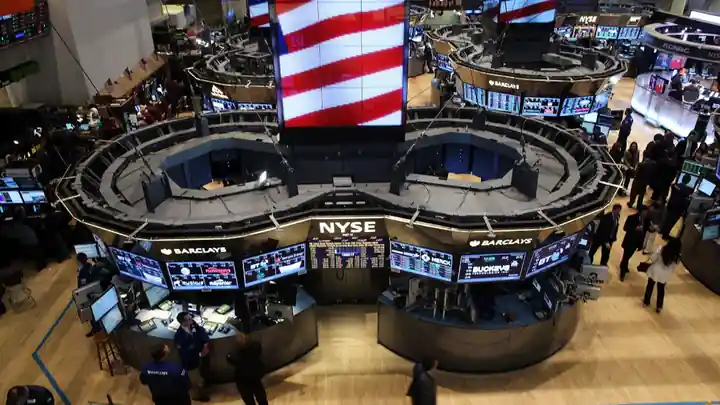
Nvidia beats and forecasts $130 billion in sales after a 955-point drop in the Dow
Nvidia reported $115.8 billion in revenue and guided to $130 billion, well above estimates, in its first report since Jensen Huang’s exit. The Dow…
-
Stocks slip as Nvidia’s results near; retail sales slow and Disney beats
Stocks edged lower ahead of Nvidia’s results as October retail sales rose just 0.2%, a Fed official called for more rate increases and Disney…
-
Stock futures slip as Nvidia’s results day arrives; Home Depot names a new CEO
Futures fell before Nvidia’s first report since Jensen Huang’s exit, while Home Depot posted 4.9% sales growth and named Richard McPhail CEO.
-
Nasdaq falls 2.5% as the AI sell-off deepens a day before Nvidia’s results
The Nasdaq fell 2.5% and the S&P 500 1.9% in a third straight loss, as Nvidia dropped 4.1% to $156.14 and the VIX jumped…
-
Stocks slide as the AI sell-off deepens before Nvidia’s results; Warsh maps AI’s risks
The S&P 500 fell for a third day as Nvidia, AMD, Broadcom and CoreWeave dropped, while Fed Chair Kevin Warsh laid out AI scenarios…
-
Stocks fall at the open as chipmakers slide a day before Nvidia’s results
The Nasdaq fell 1.4% at the open as Nvidia, AMD and Intel dropped, after Treasury Secretary Scott Bessent called for a leadership overhaul at…
About this research. Niraj Neupane contributes independent research on quantitative finance, financial economics, financial econometrics, artificial intelligence, machine learning, financial risk management, quantitative trading and financial-market technology. Research presented here may include working papers, preprints and research in progress. Unless explicitly identified as peer-reviewed or formally published, a paper should be treated as a working paper that has not undergone formal journal peer review. Findings are updated as methods, data and validation procedures evolve.
The research represents the author’s independent views unless a specific institutional or collaborative affiliation is explicitly identified, and nothing on this page is investment advice. Our sourcing, disclosure and corrections policies are set out in the Editorial Policy and Corrections Policy.