Key points
- The U.S. formally proposed new Section 301 tariffs on 14 trading partners, including China, the EU, Japan and India, over what it calls structural excess industrial capacity.
- China faces the highest proposed rate, 20%, on top of tariffs from President Trump’s first term; allies with trade deals are capped at 15% to 19%.
- Mexico and Norway are not targeted for now. The new duties would not stack on the 10% to 12.5% tariffs imposed in July.
- The plan goes through public comment and a hearing first, and implementation could slip into January.
The Trump administration on Wednesday proposed new tariffs on 14 trading partners, ending an eight-month investigation into what it calls structural excess industrial capacity, Reuters reported. The targets include China, the European Union, Japan and India.
A senior U.S. official said each of the economies “creates, sustains, or contributes to structural excess capacity and production in manufacturing sectors” through practices Washington considers unreasonable and burdensome to U.S. commerce. The countries have been notified, and congressional committees were briefed late Tuesday. Specific rates for each economy are to be published in a Federal Register notice.
Who is targeted, and at what rate
The 14 economies are China, Bangladesh, Cambodia, the European Union, India, Indonesia, Japan, South Korea, Malaysia, Singapore, Switzerland, Taiwan, Thailand and Vietnam. Mexico and Norway, which were part of the original 16-economy investigation, are not targeted for now while their reviews continue.
The official said the duties would not exceed limits already agreed in trade deals:
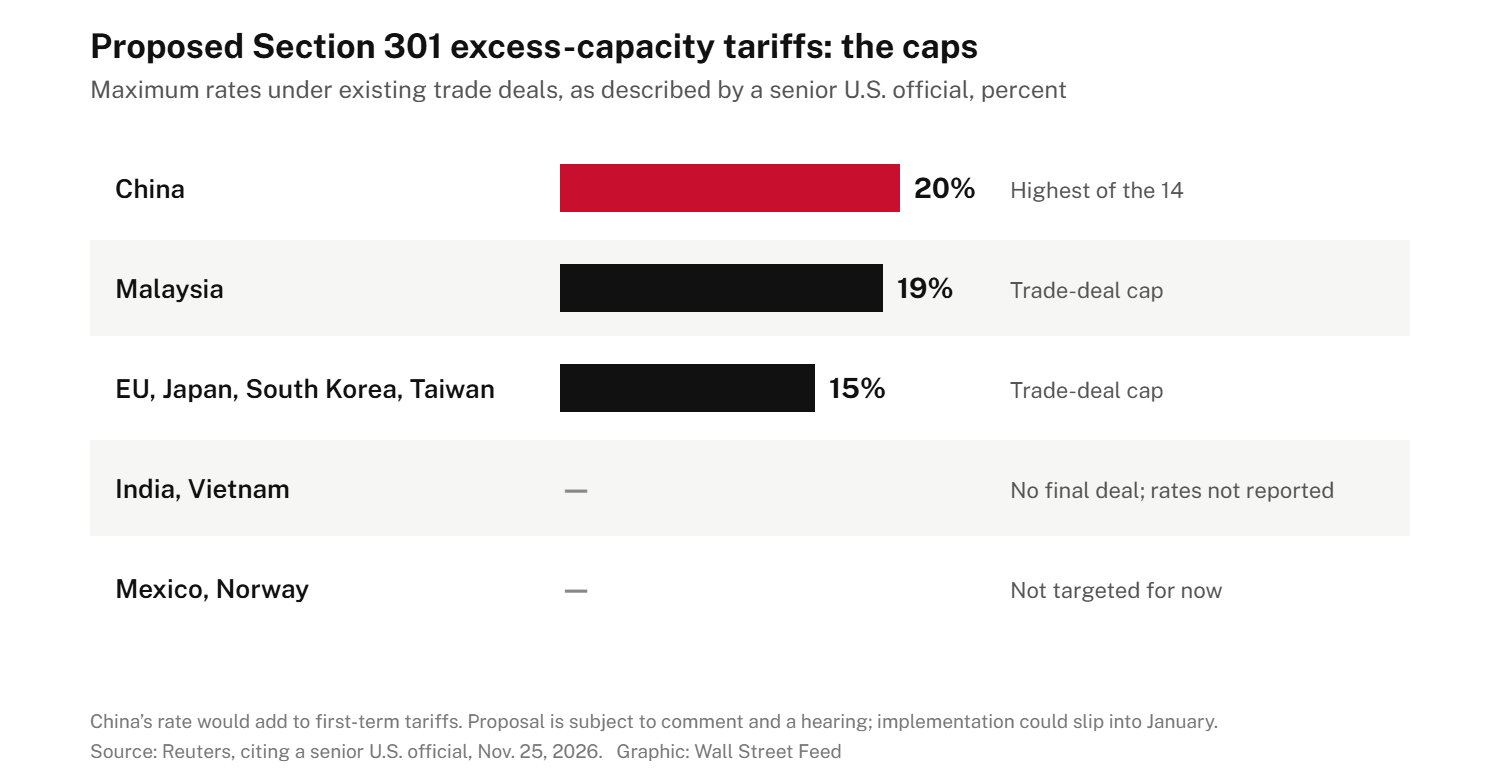
| Economy | Maximum rate | Basis |
|---|---|---|
| China | 20% | Cap under the trade truce due to expire Jan. 10; adds to first-term tariffs of about 25% |
| Malaysia | 19% | Trade-deal cap |
| EU, Japan, South Korea, Taiwan | 15% | Trade-deal caps |
| India, Vietnam | Not reported | No finalized trade deals |
| Mexico, Norway | Not targeted | Reviews continue |
Two details limit the impact. The new duties would not stack on the 10% and 12.5% tariffs imposed in July on 60 trading partners under a separate forced-labor action. And about $30 billion of Chinese imports under review for tariff cuts through a bilateral “Board of Trade” process would be exempt.
What happens next
The proposal must go through public notice, a comment period and a hearing before it can take effect, and the official said implementation could slip into January. That gives trading partners time to negotiate. The official suggested the duties could prompt more trade agreements, possibly around the Group of 20 leaders’ summit in Miami in December.
On China, the official said Washington does not expect Beijing to retaliate and pointed to progress on rare-earth supplies. “We know that they don’t like these actions, but we are seeking stability with the Chinese,” the official said. China rejects the accusation of excess capacity and says its exports reflect competitive advantages.
Analysis: rebuilding the tariff wall, carefully
This is the second piece of a broader effort to rebuild the tariffs the Supreme Court struck down in February. The first, in July, put 10% to 12.5% duties on 60 partners. This one adds targeted duties on the economies Washington considers the biggest sources of oversupply, using a law that requires findings and a formal process and is therefore much harder to challenge in court.
The design is more restrained than the headlines suggest. Allies are held to the caps they already negotiated, the new duties do not stack on July’s, a block of Chinese imports is exempt, and nothing takes effect until after a comment period. That points to a strategy of creating leverage for further deals rather than a sudden shock to prices.
For investors, the risks are concentrated rather than broad. The biggest exposure is to companies that import heavily from China and Southeast Asia, and to Asian technology supply chains. The inflation impact depends on the final rates and on how many companies negotiate exemptions or shift suppliers before January. With the Fed already raising rates and expected to move again on Dec. 9, even a modest addition to goods prices matters.
What to watch
- The Federal Register notice with each economy’s rate, especially India and Vietnam.
- Hearing dates and the length of the comment period.
- Responses from Beijing, Brussels, Tokyo and New Delhi.
- The Jan. 10 expiry of the U.S.-China trade truce.
Sources: Reuters via Devdiscourse, citing a senior U.S. official, Nov. 25, 2026; CNBC; USTR initiation notice, March 11, 2026. Rates are maximums described by the official; the final schedule will be set in a Federal Register notice.
 Full author profile →