Nvidia’s leadership crisis was a single-company event, but it moved the whole market, and that is the lesson for anyone who manages risk. Three forces met on Thursday: an index that depends on one stock, a valuation that leans on one person, and a bond market pricing in higher rates. This note works through each with the numbers.
Concentration: one stock, most of the move
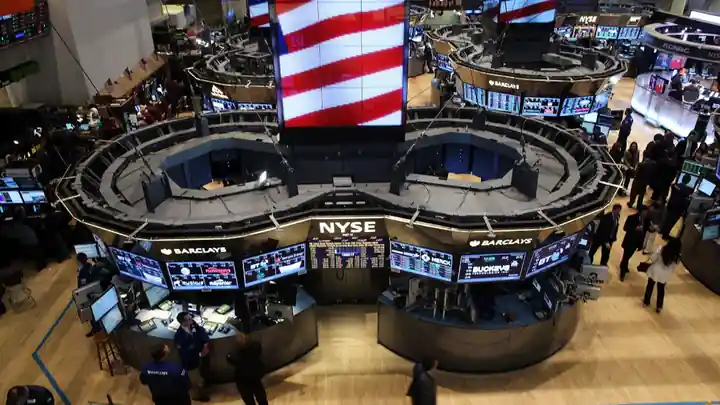
Nvidia makes up nearly 7% of the S&P 500. A rough calculation shows what that means: a 4.3% fall in a stock with about a 7% weight takes roughly 0.3 percentage points off the index. The S&P 500 fell 0.35% on Thursday, so Nvidia alone accounts for most of the day’s decline.
At the open the arithmetic was harsher. A 14% drop at a 7% weight is about 1 percentage point, which is why the Nasdaq fell as much as 1.5% in the first minutes before dip-buyers stepped in.
| Moment | Nvidia move | Approx. drag on S&P 500 | S&P 500 actual |
|---|---|---|---|
| Open (low) | about −14% | about −1.0 point | fell as much as about 0.7% |
| Close | about −4.3% | about −0.3 point | −0.35% |
For investors who hold an index fund, this is risk they did not choose. Diversification across 500 names still leaves a large exposure to one company’s governance.
Key-person risk: the hardest number to model
Founder-led companies carry value that rarely appears in a discounted cash flow model: strategy, customer relationships and speed of decisions. The market’s first estimate of what left with Jensen Huang came quickly, and it varied widely.
| View | Figure | Source |
|---|---|---|
| Fair value if Huang stays | $300 a share | Yorkville Ives |
| Fair value without Huang | about $225 a share | Yorkville Ives |
| Bernstein price target (after downgrade) | $200, from $400 | Bernstein |
| Baird price target (after downgrade) | $200, from $500 | Baird |
| Thursday close (computed) | about $166 | Wednesday close of $173.73, down 4.3% |
The spread between these views is the point. When analysts disagree by 25% or more on the value of one person, the right response for a risk manager is to treat it as a scenario, not a forecast: what happens to a portfolio if the low case is right?
Rotation: the market moved, it did not leave
Money did not flee AI on Thursday. It moved inside the theme. AMD closed up about 5.9% and Broadcom about 5.5% while Nvidia fell about 4.3%, a gap of roughly 10 percentage points in one session. Citi said investors were looking at AMD, Arista and Broadcom as alternatives.
That pattern matters for anyone hedging. A position that is long AI and short Nvidia, or long Nvidia against a broad chip index, would have behaved very differently from what a correlation estimated in calmer months suggested. Correlations inside a crowded theme tend to change exactly when they matter most.
Rates: the quieter risk that kept building
While attention stayed on Nvidia, Treasury yields rose sharply after last Tuesday’s hotter-than-expected inflation report and hawkish comments from Fed officials.
| Treasury yield | Nov. 6 close | Nov. 12 close | Change |
|---|---|---|---|
| 2-year | 4.51% | 4.88% | +37 bp |
| 10-year | 4.86% | 5.10% | +24 bp |
| 30-year | 5.26% | 5.43% | +17 bp |
| 2s10s spread | +35 bp | +22 bp | −13 bp (flatter) |
The front end rose most, which is what markets do when they price rate increases rather than long-term growth. Futures now put about 14.5% odds on a half-point increase in December, up from zero a week earlier. Small caps, which depend more on borrowing, fell 1.66% on Thursday, far more than the large-cap indexes.
What a risk manager should take from this week
- Stress the concentration, not just the volatility. A single-name shock of 15% to 20% in the largest index weight is now a plausible scenario, not a tail.
- Treat key-person risk as a scenario. Use the range of analyst values above rather than a single price target.
- Re-estimate correlations under stress. Thursday showed a 10-point gap between AI names that usually move together.
- Watch the rates channel. A 2-year yield up 37 basis points in a week affects valuations, small caps and funding costs at the same time.
- Backtests calibrated in calm markets will understate all four. That is a governance issue as much as a modeling one.
What to watch next
| Date | Event | Why it matters |
|---|---|---|
| Fri, Nov. 13 | October producer price index | A second hot inflation print would firm up December hike bets |
| Tue, Nov. 17 | Nvidia third-quarter results | First results under interim CEO Colette Kress; guidance tone is key |
| Wed, Nov. 18 | Anthropic IPO pricing | Nvidia agreed to buy about $10 billion of stock alongside the offering |
| Dec. 8–9 | Federal Reserve meeting | Markets price a likely increase from the 3.75% to 4.00% range |
Sources: Nvidia announcement and market reaction (TechCrunch, Yahoo Finance, AP); Capp Notes closing report (closes, yields, AMD and Broadcom); The Irish Times (Yorkville Ives values); Reuters via Investing.com (Citi, CME FedWatch); U.S. Treasury (Nov. 6 yields); Anthropic IPO terms as reported by Decrypt. Calculations are Wall Street Feed’s own and are approximate. This is analysis, not investment advice.
 Full author profile →