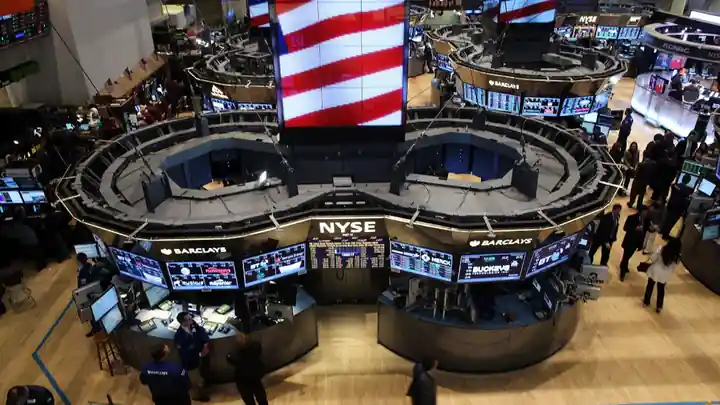

U.S. technology stocks rebounded on Friday morning, a day after a record sell-off in chip and AI shares. At the same time, a much stronger-than-expected October jobs report kept the Federal Reserve’s next move in focus. Shortly after the open the S&P 500 was up about 1% and the Nasdaq Composite about 1.9%, while the Dow lagged (Yahoo Finance, around 10 a.m. ET).
Thursday’s rout
- On Thursday the Nasdaq Composite fell 5.5%, the S&P 500 4.4% and the Dow 3.4%. For all three it was the steepest one-day drop since the April 2025 tariff announcement. S&P 500 companies lost a record $2.9 trillion in market value, and the Nasdaq closed 11.9% below its record high (Euronews).
- The Philadelphia Semiconductor Index fell 12.2%, its biggest one-day drop since 2020. Nvidia, Micron, AMD and Sandisk were among the hardest hit.
- Why: Investors worried that candidates who won in Tuesday’s midterms and pledged to slow or halt new data-center construction could restrict AI build-outs. Goldman Sachs estimates about 45% of planned U.S. data-center capacity could face restrictions from newly elected governors. Doubts about the payoff from AI spending added to the selling (Yahoo Finance).
- Friday’s rebound: Nvidia rose about 6.5% and Micron about 9% in early trading. The VIX volatility index eased to about 24 after jumping roughly 70% on Thursday.
Jobs report: 165,000 payrolls, unemployment 4.1%
Nonfarm payrolls rose by 165,000 in October, the Bureau of Labor Statistics reported. That is more than three times the prior 12-month average monthly gain of 48,000 and well above economists’ estimates. August and September were revised up by a combined 84,000. The unemployment rate was 4.1%, and average hourly earnings rose 0.4% on the month and 3.1% from a year earlier. Professional and business services added 70,000 jobs, health care 42,000, transportation and warehousing 25,000, and manufacturing 19,000. Labor force participation was 61.9%.
Traders said the strong report keeps another Fed rate increase in December under discussion, since officials are focused on inflation. The 10-year Treasury yield rose to about 4.88% after the report, from 4.84% at Thursday’s close (U.S. Treasury). The 2-year yield had fallen 12 basis points to 4.46% on Thursday as investors moved into bonds during the sell-off.
Stocks to watch
- Airbnb rose about 14% premarket after a third-quarter beat. EPS was $3.16 against $2.85 expected, revenue rose 19% to $4.87 billion, and the company raised its full-year outlook and announced a buyback.
- Cloudflare rose about 20% premarket on a third-quarter beat and stronger 2026 guidance. IREN gained about 15% on growth in AI cloud revenue, and Moderna about 8% after raising its 2026 revenue guidance.
- DraftKings fell about 26% after missing results estimates. Natera fell about 17% on a wider loss and its CEO’s departure, and Atlassian fell about 15% after signaling slower growth.
- Bitcoin fell about 4.6% to around $76,000 early Friday, pulled lower by the AI sell-off (TheStreet).
World markets and central banks
- Asia: The sell-off spread overseas. Japan’s Nikkei 225 fell as much as 7% and was down 5.7% at midday Tokyo time. South Korea’s Kospi dropped 8.8% at one point, triggering a 20-minute trading halt. Taiwan’s Taiex closed down 4.5%, and TSMC fell as much as 8.5% intraday. Hong Kong’s Hang Seng lost 0.7%, Shanghai 1.3% and Australia’s S&P/ASX 200 1%.
- Europe: Euro Stoxx 50 futures pointed about 1% lower before the open as the technology sell-off spread to Europe. Rheinmetall shares fell 17% after a profit warning tied to order delays (Euronews).
- Bank of England: The Bank of England raised Bank Rate to 4% on Thursday, its first increase in more than three years, according to its November Monetary Policy Summary.
- Brazil: The central bank’s Copom kept the Selic rate at 13.75% (Banco Central do Brasil).
- Commodities: Brent crude traded just under $100 a barrel. Traders weighed hopes for an end to the U.S.–Iran war against reports of tanker damage in the Strait of Hormuz. Gold fell about 1% to around $4,050–4,080 an ounce.
Market figures are indicative levels at the times stated and will move during the session. Sources: Bureau of Labor Statistics; U.S. Treasury; Bank of England; Banco Central do Brasil; Yahoo Finance; TheStreet; Euronews.
 Full author profile →