Key points
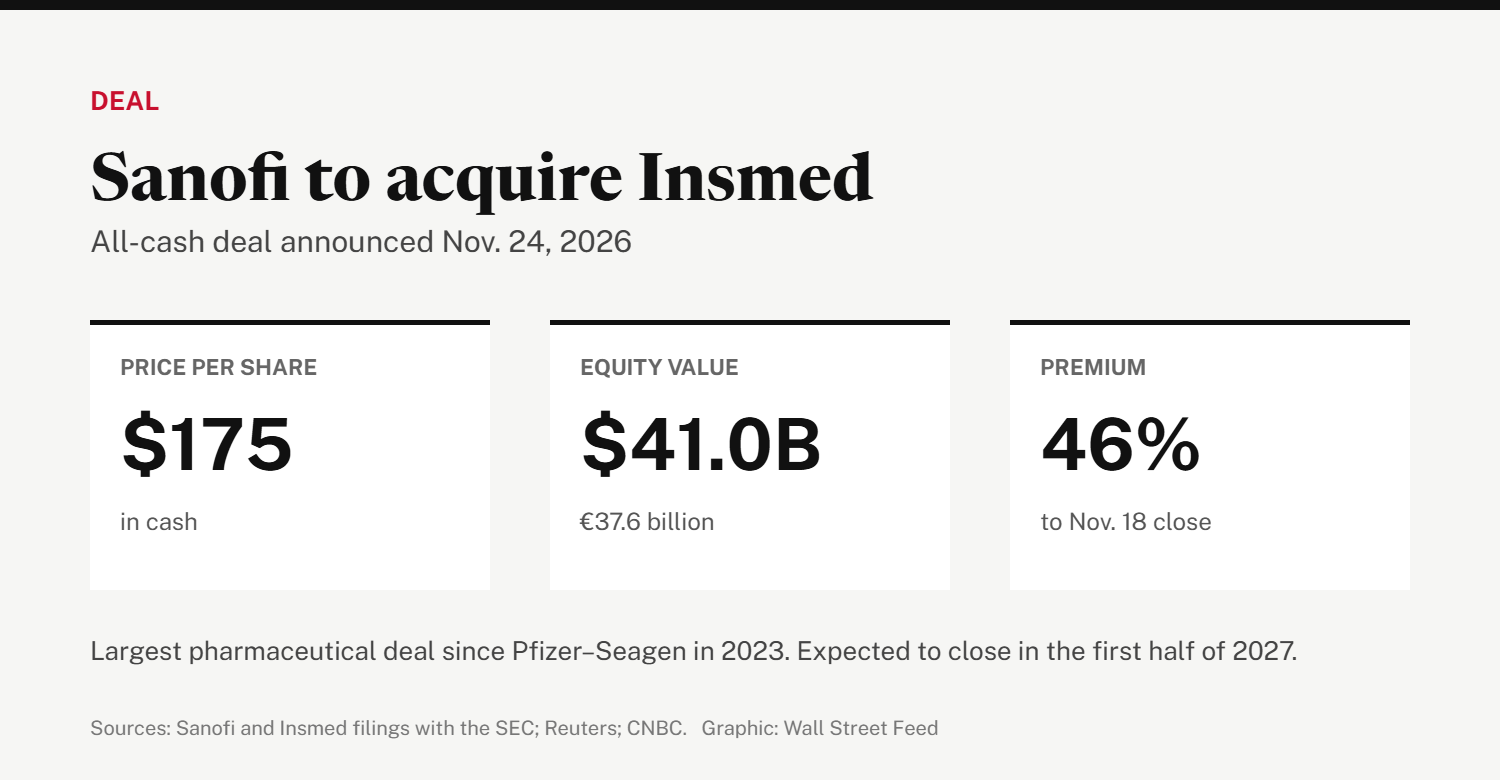
- Sanofi agreed to buy Insmed for $175 a share in cash, valuing the respiratory-drug maker at about $41.0 billion.
- The price is 46% above Insmed’s close on Nov. 18, before reports of talks, and about 17.5% above Monday’s close.
- It is the largest pharmaceutical deal since Pfizer bought Seagen in 2023; Insmed shares rose about 14%.
- The deal needs shareholder and regulatory approval and is expected to close in the first half of 2027.
Sanofi said on Tuesday that it had agreed to acquire Insmed for $175 a share in cash, a deal that values the U.S. respiratory-drug maker at about $41.0 billion, or €37.6 billion. It is the biggest acquisition yet under Sanofi Chief Executive Belen Garijo and the pharmaceutical industry’s largest deal since Pfizer agreed to buy Seagen for $43 billion in 2023, CNBC reported.
The price is about 46% above Insmed’s closing price on Nov. 18, the day before reports that Sanofi was weighing a bid, and about 17.5% above Monday’s close, Reuters reported. Insmed shares rose about 14% in morning trading, leaving them below the offer price, a typical gap that reflects the time and risk until the deal closes.
What Sanofi is buying
Insmed has two approved medicines and a late-stage pipeline, according to the companies’ announcement:
- Brinsupri (brensocatib): a once-daily pill for non-cystic fibrosis bronchiectasis, a chronic lung disease. It launched in the U.S. in August 2025 and brought in $1.09 billion in revenue through Sept. 30, 2026.
- Arikayce: an inhaled antibiotic for a hard-to-treat lung infection. Revenue in 2025 was $433.8 million, up 19%.
- TPIP: an inhaled treatment in Phase 3 trials that Sanofi sees as a growth driver beyond 2030. It is not approved anywhere.
Garijo called the deal “a major strategic step to significantly accelerate our mid- and long-term growth trajectory.” Insmed Chair and CEO Will Lewis said it “delivers immediate, certain cash value for Insmed shareholders.”
| Term | Detail |
|---|---|
| Price | $175 a share, all cash |
| Equity value | About $41.0 billion (€37.6 billion) |
| Premium | About 46% to the Nov. 18 unaffected close |
| Financing | Debt and cash on hand; committed financing secured |
| Approvals needed | Insmed shareholders; U.S. and some non-U.S. regulators |
| Expected close | First half of 2027 |
| Earnings impact | Expected to add to Sanofi’s business EPS by the end of 2028 |
Analysis: why pay this much
Big drugmakers face a common problem: patents on some of their best-selling medicines expire over the next several years, and they need new sources of revenue to replace them. Buying a company with a fast-growing approved drug is quicker than developing one from scratch, which can take a decade or more.
Brinsupri is the core of the deal. A drug that crossed $1 billion in sales in its first full year on the market is rare, and bronchiectasis had no approved treatment before it. Sanofi already sells Dupixent, one of the world’s best-selling drugs, in respiratory conditions, so it can use its existing sales force and relationships with lung specialists.
The risk is the price. Sanofi is paying a large premium and taking on debt, and it does not expect the deal to add to earnings until the end of 2028. That puts a lot of weight on Brinsupri continuing to grow and on TPIP succeeding in late-stage trials. The deal also needs regulatory approval in the U.S. and abroad.
What to watch
- Whether another bidder emerges. Insmed’s shares trading below $175 suggests investors are not expecting one.
- Regulatory review in the U.S. and abroad.
- Sanofi’s share reaction and any change to its buyback or dividend plans as it takes on debt.
Sources: Sanofi and Insmed announcement and SEC filings, Nov. 24, 2026; Reuters via RTÉ; CNBC.
 Full author profile →