Key points
- Stock futures rose about 2% Sunday night after Wall Street’s worst week since April 2025.
- Asia stayed weak: the KOSPI slid as much as 4.5% and the Hang Seng 1.8%.
- Brent slipped to $92.29 despite new tanker strikes in the Gulf.
- Monday’s cash session is the real test of whether the selling has run its course.
U.S. stock futures jumped on Sunday night as buyers returned after Wall Street’s worst week since April 2025, but the rebound did not reach Asia’s chip-heavy markets, where the AI sell-off kept going.
As of 9:16 p.m. ET, futures tied to the Dow Jones Industrial Average were up 798 points, or 1.66%, S&P 500 futures were up 2.11% and Nasdaq futures were up 2.75%, Fortune reported. Treasury futures fell and the yen weakened as demand for haven assets eased, Bloomberg reported.
Where the week left off
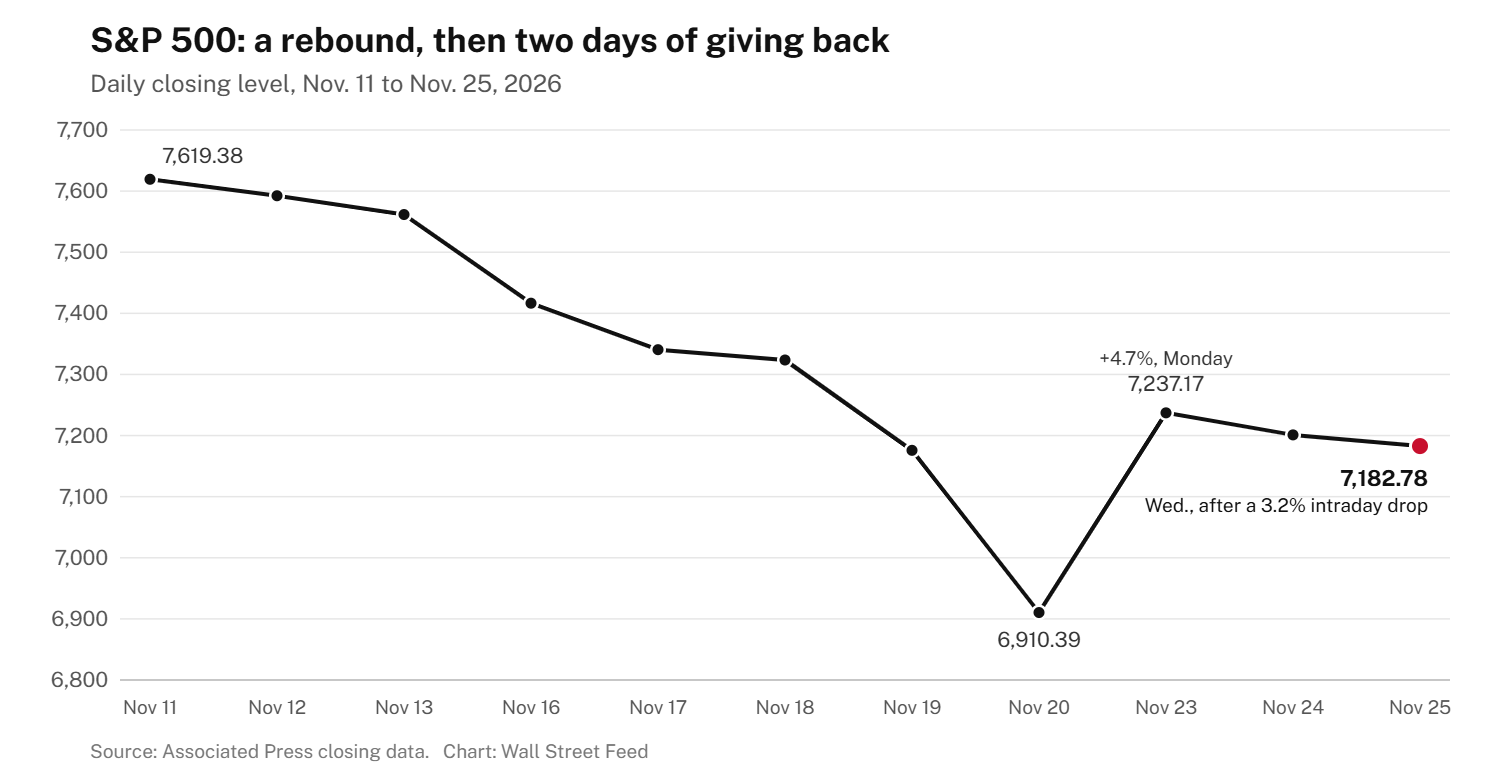
The bounce starts from deep losses. Friday’s session pushed all three major U.S. indexes into correction, more than 10% below their records, and capped the S&P 500’s seventh straight daily decline.
| Index | Close, Nov. 20 | Friday | Week |
|---|---|---|---|
| S&P 500 | 6,910.39 | −3.70% | −8.6% |
| Nasdaq Composite | 22,617.73 | −5.28% | −10.0% |
| Dow Jones Industrial Average | 48,147.33 | −1.93% | −8.0% |
| Russell 2000 | 2,581.79 | −2.76% | −7.5% |
Asia did not join the bounce
- South Korea: The KOSPI slid as much as 4.5% in morning trading on Monday, Al Jazeera reported, despite the government saying on Sunday that it was ready to deploy market stabilization funds.
- Hong Kong and China: The Hang Seng fell 1.8% and the CSI 300 in Shanghai dropped more than 1.3%.
- Taiwan: The Taiex swung between gains and losses after authorities said they were considering lowering margin requirements for investors using borrowed money, according to Market Index.
- Japan: Markets were closed for the Labor Thanksgiving Day holiday, which thinned trading across the region.
Oil shrugs off the tanker strikes
Brent crude fell 28 cents, or 0.3%, to $92.29 a barrel by 9:16 p.m. ET, Reuters reported, after settling at $92.57 on Friday. U.S. crude for January delivery slipped 15 cents to $83.26. Reuters said the broader market sell-off spilled into commodities, while continuing attacks on Gulf shipping limited the losses.
What the split tells us
The overnight move looks more like relief than a change of view. After a seven-day losing streak that pushed all three major U.S. indexes into correction, futures were primed to bounce. Asia’s markets, where Samsung Electronics, SK Hynix and Taiwan’s chipmakers carry heavy weight, are a purer test of confidence in AI spending, and they are still falling.
Oil points the same way. Two tankers were hit in the Strait of Hormuz this weekend, yet Brent slipped. That suggests investors are still more worried about slower growth than about lost supply, the pattern that drove crude lower last week.
Rebounds after sharp sell-offs are common, and futures trading on a Sunday night is thin. Whether this bounce holds will depend on the cash session and the data later in the week.
How to read a Sunday-night bounce
Three things will decide whether the rebound lasts. The first is breadth. Last week’s selling hit every sector, and a durable recovery usually needs more than a handful of beaten-down chip stocks to rise. The second is the bond market: Treasury futures fell on Sunday night as investors moved out of safe assets, and a sharp rise in yields would make it harder for stocks to recover, especially with the Fed expected to raise rates on Dec. 9. The third is Asia. The chip-heavy markets of South Korea and Taiwan have been the clearest gauge of confidence in AI spending, and they were still falling on Monday.
There is also a calendar effect. This is a holiday-shortened week, with markets closed Thursday for Thanksgiving and closing early on Friday. Thin trading can exaggerate moves in either direction, so a big gain or loss on light volume says less than it would in a normal week.
What to watch this week
- Whether Monday’s cash session holds the futures gains, and whether chip stocks join in.
- Dell Technologies’ results after the close on Tuesday, a read on demand for AI servers.
- October PCE inflation and third-quarter GDP on Wednesday, Nov. 25.
- U.S. markets close on Thursday for Thanksgiving and close early on Friday.
Sources: Fortune; Bloomberg; CNBC; Al Jazeera; Market Index; Reuters; Associated Press.
 Full author profile →