Key points
- The S&P 500 fell as much as 3.2% and the Nasdaq 100 briefly entered a bear market before stocks recovered most of the losses; the S&P 500 closed down 0.3%.
- Core PCE inflation rose to 3.3% in October, above the 3.2% forecast and the highest since November 2023, while third-quarter growth was revised up to 4.3%.
- Nvidia fell 3.9% for a second straight loss; Anthropic swung from a near-10% drop to a small gain.
- For the holiday week so far, the S&P 500 is up 3.9%; markets are closed Thursday and close at 1 p.m. ET on Friday.
Wall Street clawed back most of a steep early slide on Wednesday, ending a volatile day before Thanksgiving with only modest losses despite hotter-than-expected inflation, new tariff proposals and a second day of selling in artificial intelligence stocks.
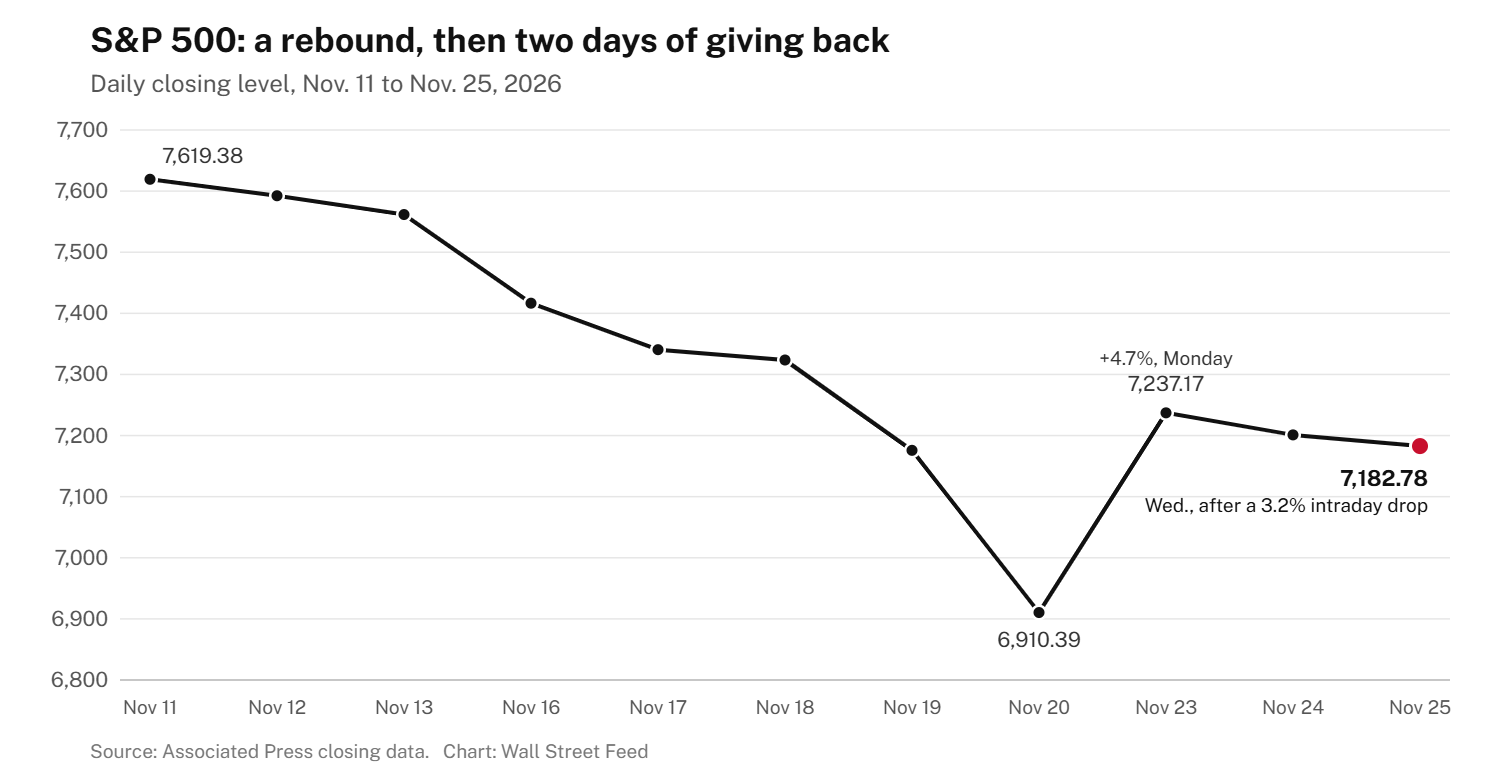
The S&P 500 fell 18.31 points, or 0.3%, to 7,182.78, after being down as much as 3.2% in the morning. It was the index’s ninth loss in 10 trading days. The Nasdaq Composite fell 147.73 points, or 0.6%, to 23,585.80. The Dow Jones Industrial Average rose 164.25 points, or 0.3%, to 50,182.95, and the Russell 2000 index of smaller companies gained 19.12 points, or 0.7%, to 2,704.06, according to the Associated Press. Treasury yields fell.
| Index | Close | Day | Week so far | Year to date |
|---|---|---|---|---|
| S&P 500 | 7,182.78 | −0.3% | +3.9% | +4.9% |
| Dow Jones Industrial Average | 50,182.95 | +0.3% | +4.2% | +4.4% |
| Nasdaq Composite | 23,585.80 | −0.6% | +4.3% | +1.5% |
| Russell 2000 | 2,704.06 | +0.7% | +4.7% | +9.0% |
A morning rout, an afternoon recovery
The early selling was severe. The Nasdaq Composite fell as much as about 4.6% and the Dow more than 1,100 points, UPI reported. The Nasdaq 100, which holds the largest technology companies, briefly fell more than 20% below its record high, the common definition of a bear market, before rebounding, NBC News reported.
Buyers returned as the day went on, mostly outside technology. “Investors are just selling tech and fleeing for safety,” Jed Ellerbroek, a portfolio manager at Argent Capital Management, told CNN. Small caps and the Dow finished higher, a pattern that has now held for two days: money is leaving AI and moving into the rest of the market rather than leaving stocks altogether.
AI stocks fall again
Nvidia fell 3.9%, its second straight decline after Monday’s 31% jump on Jensen Huang’s return, CNN reported. Earlier in the day it had been down about 7%. Memory chipmaker Micron fell about 10% in the morning, and the sell-off was global: SoftBank Group dropped about 15% in Tokyo, CNBC reported.
Anthropic was the day’s outlier. After closing Tuesday below its $83 IPO price, the stock dropped almost 10% before reversing to end slightly more than 1% higher, according to CNN. HP Inc. jumped about 11.5% after its earnings report.
Inflation runs hotter, growth runs faster
| Measure | Previous | Forecast | Actual |
|---|---|---|---|
| PCE prices, year over year (Oct.) | 3.6% | 3.8% | 3.8% |
| Core PCE, year over year (Oct.) | 3.1% | 3.2% | 3.3% |
| PCE and core PCE, month over month | 0.5% / 0.3% | 0.3% / 0.3% | 0.3% / 0.3% |
| Real GDP, Q3, annual rate | 3.4% (advance) | 3.5% | 4.3% |
Core PCE inflation, which excludes food and energy and is the Federal Reserve’s preferred measure of underlying price pressure, rose to 3.3% in October from 3.1%, the largest increase since November 2023, Reuters reported. Headline PCE inflation reached 3.8%, in line with forecasts.
Growth was far stronger than first thought. The government revised third-quarter growth to a 4.3% annual rate from 3.4%, the fastest pace since the third quarter of 2023. Final sales to private domestic purchasers, a measure of underlying demand that excludes inventories, trade and government, grew at a 5.8% rate, the fastest since the second quarter of 2021. Personal income rose 0.7% in October, but real consumer spending was roughly flat.
Tariffs add to the pressure
Before the open, the administration formally proposed new Section 301 tariffs on 14 trading partners over what it calls structural excess industrial capacity, Reuters reported. China faces the highest rate, 20%, on top of tariffs from President Trump’s first term, while the EU, Japan, South Korea and Taiwan are capped at 15% and Malaysia at 19%. Mexico and Norway are not targeted for now.
The proposal goes through public comment and a hearing, and implementation could slip into January, so it does not change prices immediately. But it adds another source of upward pressure on goods inflation at a time when core inflation is already rising. That reinforces the Fed’s case for higher rates, which is the same force weighing on technology stocks. Our full report on the tariff plan.
Analysis: an economy too strong for the Fed’s comfort
Wednesday’s data confirm a difficult combination for the Federal Reserve: inflation is drifting higher and the economy is growing well above its long-run pace. That leaves little doubt about a rate increase on Dec. 9, which markets had already almost fully priced. The bigger question is how many more increases follow in 2027.
For stocks, that is the core of the problem. Higher rates hurt richly valued growth companies most, because more of their expected profits lie far in the future. That helps explain why AI stocks have fallen for two days while small caps, which are up 9% this year, keep rising. The market is not giving up on stocks; it is repricing which stocks can handle a world of higher rates and new tariffs.
The afternoon recovery is a sign that buyers are still willing to step in. But the S&P 500 has now fallen in nine of the last 10 sessions, and Monday’s rally has been mostly undone. The holiday-shortened Friday session, with thin trading, is unlikely to settle the question.
What to watch
- Friday: markets reopen for a shortened session, closing at 1 p.m. ET. Light volume can exaggerate moves.
- Tariffs: the Federal Register notice with rates for each of the 14 economies. Our report.
- Next week: Nvidia CEO Jensen Huang’s appearances before House and Senate panels on Dec. 1 and Dec. 3, and the November jobs report on Dec. 4.
- The Fed: its rate decision on Dec. 9.
Sources: Associated Press (closing levels, weekly and year-to-date changes); Reuters (tariffs); Bureau of Economic Analysis via Reuters (Kitco) and Benzinga; CNN; NBC News; UPI; CNBC; Yahoo Finance; Swingfolio (HP Inc.).
 Full author profile →