Key points
- The Nasdaq fell 1.5% and the S&P 500 0.5% as AI stocks gave back part of Monday’s rally; the S&P 500 has now fallen in eight of the last nine sessions.
- The Dow rose 423 points to close back above 50,000, and the small-cap Russell 2000 gained 0.6%, as most stocks outside tech rose.
- Nvidia fell about 5.9% and Anthropic closed below its $83 IPO price for the first time.
- Oil rose more than 2% on new tanker attacks near Hormuz; Wednesday brings PCE inflation and GDP data before the Thanksgiving break.
Wall Street split in two on Tuesday. Stocks tied to artificial intelligence gave back part of Monday’s historic rally, pulling the Nasdaq and the S&P 500 lower, while most of the rest of the market rose along with Americans’ confidence in the economy.
The S&P 500 fell 36.08 points, or 0.5%, to 7,201.09, its eighth loss in the last nine days. The Nasdaq Composite dropped 356.02 points, or 1.5%, to 23,733.54. The Dow Jones Industrial Average rose 423.39 points, or 0.9%, to 50,018.70, and the Russell 2000 index of smaller companies gained 15.29 points, or 0.6%, to 2,684.94, according to the Associated Press.
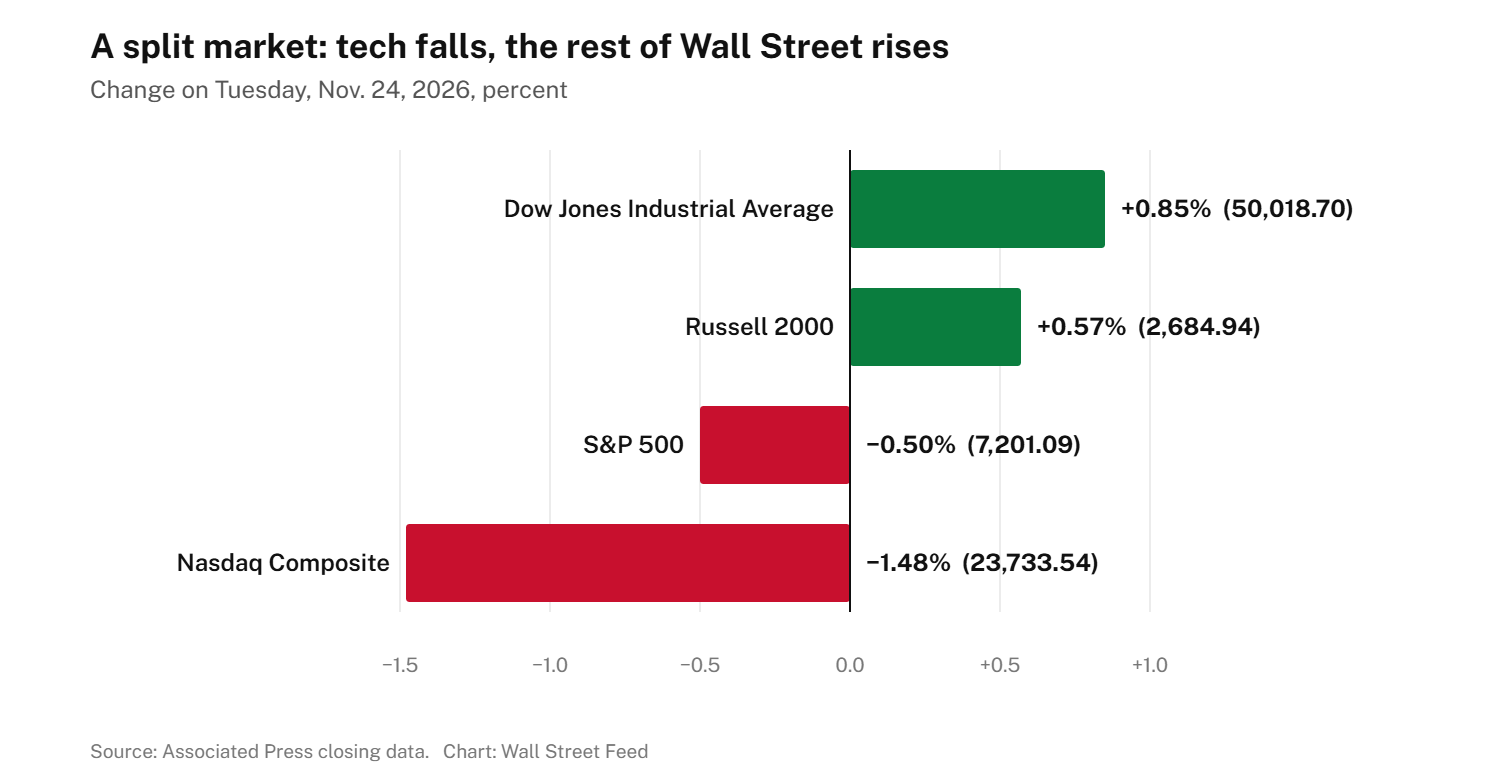
| Index | Close | Day | Week so far | Year to date |
|---|---|---|---|---|
| S&P 500 | 7,201.09 | −0.5% | +4.2% | +5.2% |
| Dow Jones Industrial Average | 50,018.70 | +0.9% | +3.9% | +4.1% |
| Nasdaq Composite | 23,733.54 | −1.5% | +4.9% | +2.1% |
| Russell 2000 | 2,684.94 | +0.6% | +4.0% | +8.2% |
AI stocks retreat
Nvidia fell about 5.9% a day after its 31% jump on Jensen Huang’s return as chief executive, as investors weighed the political and governance questions around his reinstatement, Reuters reported. Technology was the weakest of the S&P 500’s 11 sectors, down 2.8%.
Anthropic fell more than 6% to under $82, closing below its $83 IPO price for the first time, Quartz reported. The stock has fallen every session since its Nov. 19 debut, when it opened at $111.50. Canaccord Genuity started coverage with a buy rating on Tuesday, and CNBC reported that analysts remain largely positive on the company’s long-term prospects.
Dell fell 11.8% during the session ahead of its earnings report, then rose about 4% after the bell when it reported record quarterly revenue of $54.94 billion, well above the $49.24 billion analysts expected, according to Investing.com.
Why the rest of the market rose
Outside technology, the picture was brighter. The Conference Board’s consumer confidence index jumped to 103.3 in November from 91.9, its highest level since January 2025, Reuters reported. Retailers rallied after strong results, led by Abercrombie & Fitch, which jumped more than 20% in early trading after record third-quarter sales of $1.4 billion. Kohl’s, which reported its first rise in comparable sales in a long stretch, and Best Buy also beat estimates.
Health care got a lift from deal news. Sanofi agreed to buy Insmed for $175 a share in cash, or about $41 billion, the pharmaceutical industry’s biggest deal since 2023. Our report on the deal.
The Dow’s gain and the S&P 500’s loss on the same day show how much the cap-weighted index depends on a few giant technology companies. An equal-weighted version of the S&P 500, which gives every company the same weight, rose about 0.5%, according to CappNotes.
Oil, bonds and tariffs
Oil reversed from three-month lows. Brent crude for January rose $2.03, or 2.3%, to settle at $91.40 a barrel, and U.S. crude rose $1.88 to $82.05 after reports of new attacks on ships in and around the Strait of Hormuz, according to Reuters and Bloomberg. Trading volume was thin ahead of Thursday’s holiday, which can exaggerate moves.
Treasury yields were little changed, with the 10-year near 4.90%. A $70 billion five-year note sale drew average demand at a 4.719% yield.
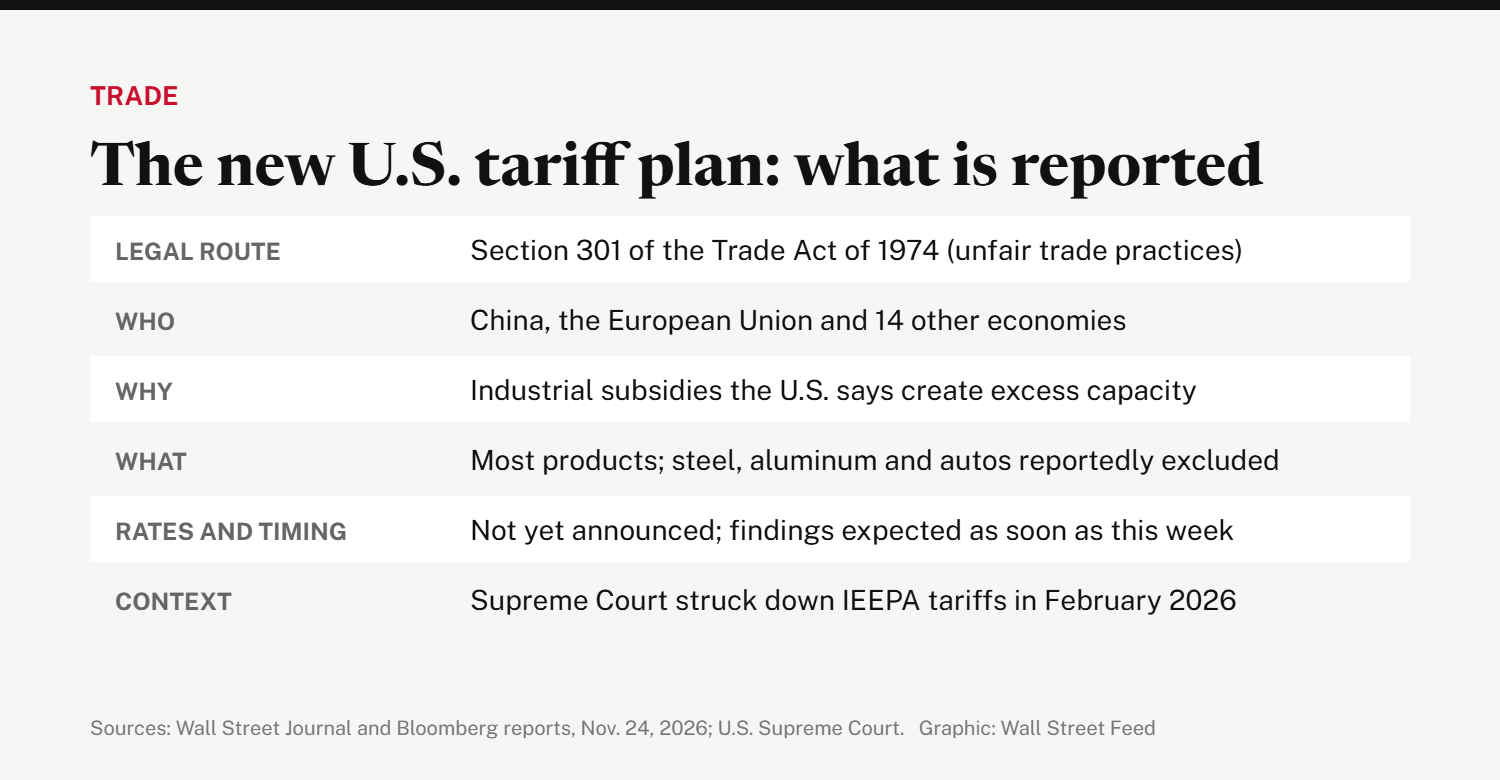
Investors also weighed reports that the U.S. is preparing new tariffs on China, the European Union and 14 other economies. As of Tuesday evening, no official announcement had been made. According to the Wall Street Journal, economies with existing trade deals, such as the EU, Japan and South Korea, would likely face rates of no more than 15%, while China, India and Vietnam could face higher duties. Our tariff explainer.
After the bell
Earnings after the close sent several technology stocks sharply in both directions. Dell rose about 4% in extended trading after adjusted earnings of $9.45 a share, far above the $6.56 analysts expected, and a raised full-year forecast, Investing.com reported. The AI server maker’s results are a direct read on demand for the data-center equipment at the center of the AI spending debate, and on Tuesday that demand looked strong.
Workday fell about 7% after hours even though its earnings and revenue beat expectations, after its free cash flow disappointed investors, CNBC reported. Chipmaker Ambarella dropped about 38% in after-hours trading after its report, according to Stock Titan.
The contrast is a useful reminder for the week ahead: strong results alone are not enough. Investors are judging each company on what its numbers say about the durability of AI spending and on whether its outlook justifies its price.
Analysis: a market that cannot pick a story
Monday and Tuesday together show a market pulled between two stories. On Monday, investors bought the AI trade as if Nvidia’s leadership crisis was the only problem. On Tuesday, they sold the same stocks and bought almost everything else.
That rotation is a sign the AI sell-off is not fully over. The questions that drove it, about whether spending on AI will keep paying off, how the Fed will handle inflation near 3.5%, and now new tariffs, are still open. Monday’s rally answered only one of them.
The broader market looks healthier than the headline index suggests. Small caps are up 8.2% for the year, compared with 2.1% for the Nasdaq, and consumers are more confident than at any point in nearly two years. But a strong consumer is a double-edged sword: it supports profits while giving the Fed less reason to stop raising rates.
What to watch Wednesday
- 8:30 a.m.: October PCE inflation, the Fed’s preferred measure, and the second estimate of third-quarter GDP.
- Tariffs: the USTR announcement and the rates for each economy.
- Earnings reaction: Dell, Workday and Ambarella after their after-hours moves.
- Holiday schedule: markets are closed Thursday and close at 1 p.m. ET on Friday.
Sources: Associated Press (closing levels and weekly and year-to-date changes); Reuters via NBC News; Quartz; CNBC; Investing.com; Stock Titan; Bloomberg via Rigzone; Reuters via Forbes Middle East (oil settlements); U.S. Treasury auction results; Wall Street Journal via WWD; CappNotes (equal-weight index).
 Full author profile →