Key points
- U.S. markets are closed for Thanksgiving; stocks in Europe and Asia rose as investors bought back technology shares after the AI sell-off.
- Germany’s DAX rose about 1.9% and Taiwan’s Taiex 2.5%; SoftBank jumped 7.3% a day after a 15% drop.
- China, the EU, Japan and others pushed back against the proposed U.S. tariffs; Beijing called the overcapacity rationale a “false premise.”
- The Bank of Korea raised its rate to 3.25%, its third increase this year, and Nvidia reportedly halted server shipments to four Southeast Asian countries.
With Wall Street closed for Thanksgiving, markets in Europe and Asia carried a rebound in technology stocks on Thursday, as investors returned to chipmakers that had been sold heavily earlier in the week and looked past new U.S. tariff proposals.
U.S. stock futures were up about 0.5% in the morning, the Associated Press reported. U.S. markets reopen on Friday for a shortened session that closes at 1 p.m. ET.
Europe rallies, led by tech
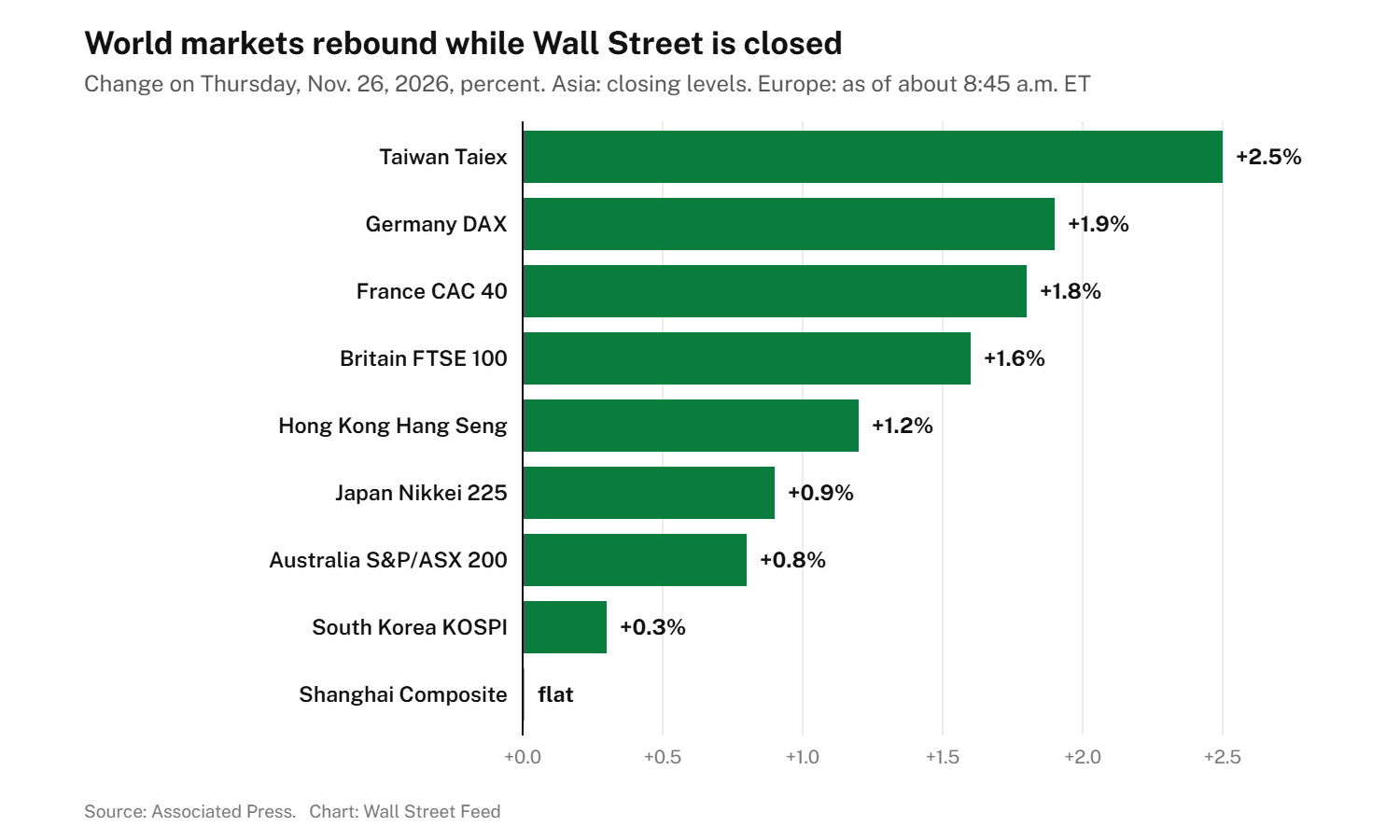
In Europe, Germany’s DAX rose 1.9% to 25,180.12 and France’s CAC 40 1.8% to 8,126.47 in morning trading, while Britain’s FTSE 100 gained 1.6% to 10,591.83, according to the AP. The pan-European Stoxx 600 was up about 1.6% around midday in London, with every sector higher, and the region’s technology index rose 2.5%, CNBC reported. German chipmaker Infineon gained more than 4%.
Asia: chips bounce back
| Index | Close | Change |
|---|---|---|
| Japan Nikkei 225 | 57,499.16 | +0.9% |
| Hong Kong Hang Seng | 22,226.88 | +1.2% |
| South Korea KOSPI | 4,711.21 | +0.3% |
| Australia S&P/ASX 200 | 8,763.80 | +0.8% |
| Shanghai Composite | 3,476.88 | Flat |
| Taiwan Taiex | Not reported | +2.5% |
SoftBank Group, a major investor in OpenAI, jumped 7.3% in Tokyo after falling about 15% on Wednesday, and memory maker Kioxia surged 12.6%, the AP reported. In Seoul, SK Hynix rose 2.2%, but the KOSPI gained only 0.3% after a 6.2% drop the day before. It had been up as much as about 2.6% before the Bank of Korea’s rate decision.
The Bank of Korea raises rates
South Korea’s central bank raised its benchmark rate by a quarter point to 3.25% in a 5-2 vote, its third increase this year after hikes in July and August and its highest level since November 2024, Bloomberg and Korean media reported. It also sharply raised its growth forecasts on the strength of semiconductor exports, lifting its 2027 outlook to 4.1%, according to the Seoul Economic Daily.
The decision matters beyond Korea. It is another sign that the global AI boom is producing strong growth and lasting inflation pressure, the same combination that is pushing the U.S. Federal Reserve toward another rate increase on Dec. 9. The median projection of Korea’s policymakers points to a 3.5% rate within six months.
Trading partners push back on tariffs
China, the European Union, Japan and other targets of the proposed U.S. Section 301 tariffs rejected Washington’s claim that they produce excess manufacturing capacity, the AP reported. China called the overcapacity rationale a “false premise” and said it reserves the right to take necessary measures to protect its interests. An EU spokesperson rejected the idea that Europe is a source of structural overcapacity, while Japan, Singapore and Malaysia also denied the charge.
The responses so far point to negotiation rather than immediate retaliation. Singapore and Japan signaled they prefer talks, according to The Private Banker. The U.S. and China have also extended their trade truce by two months to Jan. 10, 2027, and agreed on tariff cuts on lists of non-sensitive products worth about $60 billion, the AP reported. Our report on the tariff plan.
Nvidia halts shipments to Southeast Asia
Nvidia has told its manufacturing partners to stop shipping servers with its chips to Malaysia, Singapore, Thailand and Indonesia, the Financial Times reported, as Washington tightens rules meant to stop Chinese firms from obtaining advanced AI chips through the region. Our full story.
Analysis: a holiday rebound, not a verdict
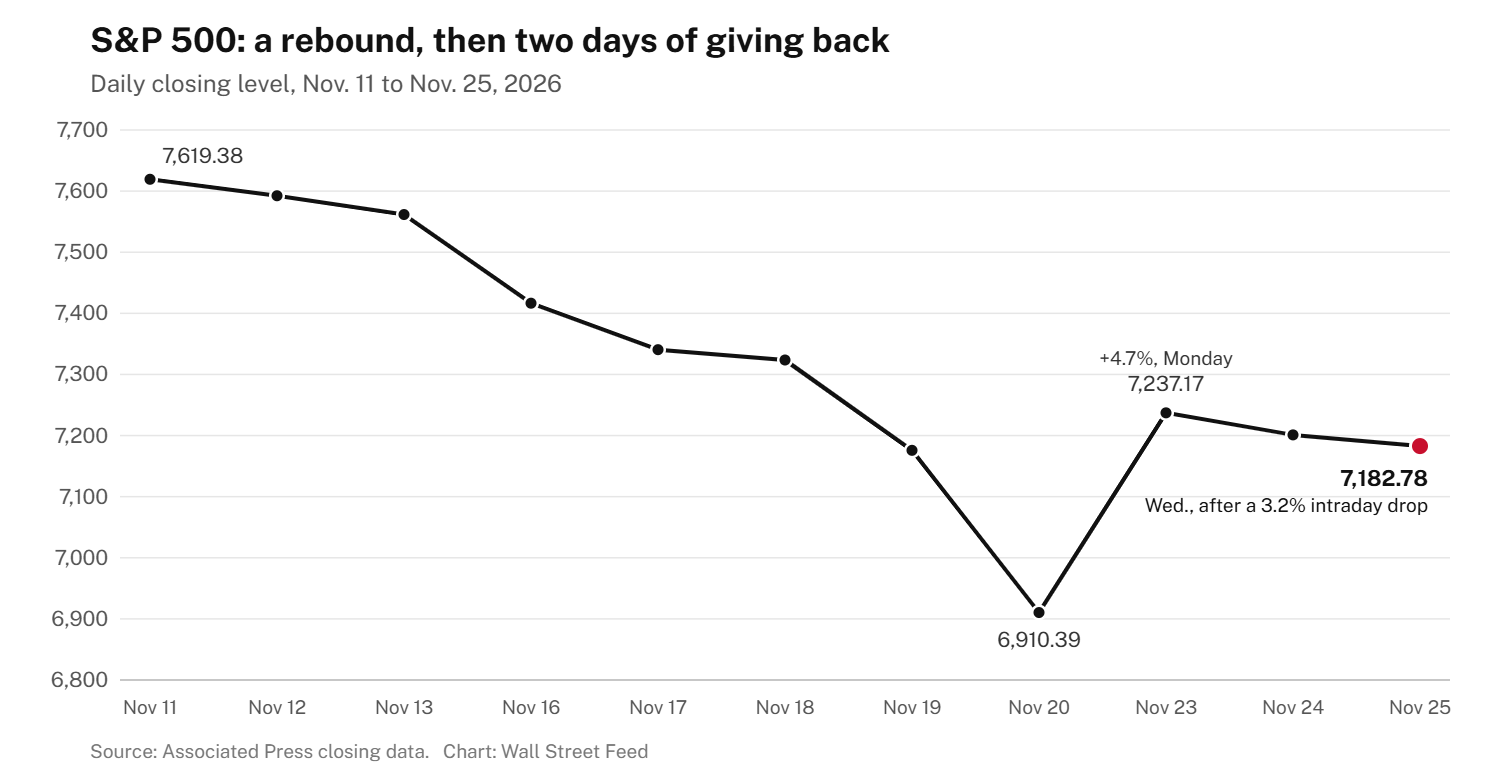
Thursday’s gains abroad mirror Wednesday afternoon’s recovery on Wall Street, when the S&P 500 erased most of a 3.2% drop. Investors are clearly willing to buy chip stocks after sharp declines, which is a sign the AI trade still has supporters.
But the forces behind the sell-off have not changed. Central banks from Seoul to Washington are raising rates to contain inflation driven partly by AI investment, new U.S. tariffs are coming, and Nvidia faces new export restrictions and congressional hearings next week. Holiday trading is also thin, which can exaggerate moves in either direction. Friday’s shortened U.S. session will be the first test of whether Thursday’s rebound carries over.
What to watch
- Friday: U.S. markets reopen for a shortened session, closing at 1 p.m. ET.
- Black Friday: early reads on holiday spending, after strong consumer confidence this week.
- Next week: Jensen Huang’s congressional testimony on Dec. 1 and Dec. 3, and the November jobs report on Dec. 4.
Sources: Associated Press (European and Asian index levels, tariff reactions, U.S.-China truce); CNBC (Stoxx 600, Infineon); Bloomberg, SBS News, Seoul Economic Daily and Korea JoongAng Daily (Bank of Korea); The Private Banker; Financial Times via Reuters (Nvidia). European figures are intraday.
 Full author profile →