Key points
- Adobe expects U.S. shoppers to spend $12.9 billion online on Black Friday, up 9.2% from a year ago.
- Deloitte says 87% of consumers plan to shop over the five-day Thanksgiving weekend, the highest since 2016; the NRF expects slightly fewer shoppers than it forecast last year.
- Most consumers expect tariffs to raise prices: 84% in an NRF survey.
- Strong confidence but flat real spending make the weekend an important test of the consumer.
Black Friday arrives with consumers in a better mood than at any time in nearly two years, but facing the highest inflation of the year and the prospect of new tariffs. Forecasts point to another record for online spending, though the number of shoppers may not grow.
What the forecasts say
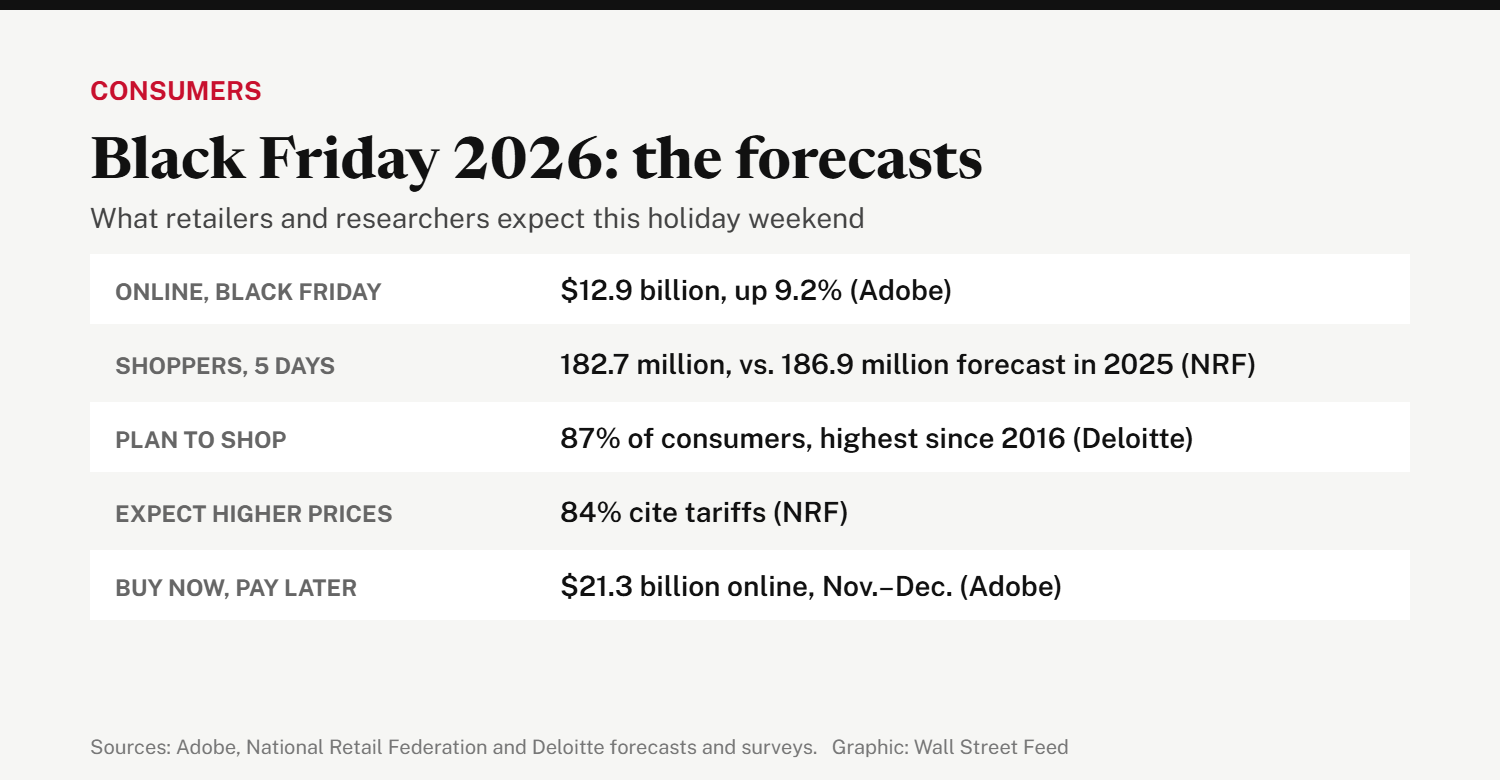
Adobe forecasts that consumers will spend $12.9 billion online on Black Friday, up 9.2% from a year earlier, NBC News reported. Adobe also expects buy now, pay later services to drive $21.3 billion in online spending in November and December.
Participation looks strong. In Deloitte’s Black Friday–Cyber Monday survey of 1,200 consumers, 87% said they plan to shop during the five days from Thanksgiving through Cyber Monday, up from 82% last year and the highest since 2016. The National Retail Federation is less optimistic, projecting 182.7 million shoppers over the period, slightly below the 186.9 million it forecast a year ago.
Prices and tariffs
Inflation is a headwind. The Fed’s preferred inflation measure rose 3.8% in October, with higher prices for food, household furnishings, dining out and hotel stays. According to the NRF, 84% of consumers expect higher prices this holiday season because of tariffs, and the administration proposed a new round of tariffs on 14 trading partners on Wednesday, though they would not take effect before January. Our report on the tariff plan.
Analysis: a confident consumer, a cautious wallet
The data send mixed signals. The Conference Board’s consumer confidence index jumped to 103.3 in November, its highest since January 2025, and household income rose 0.7% in October. But real consumer spending, adjusted for inflation, was roughly flat in October. Consumers feel better, but inflation is absorbing much of their extra income.
That fits the forecasts: record online dollars, partly because prices are higher, and fewer people out shopping. Heavy use of buy now, pay later is another sign that some households are stretching budgets to keep spending.
Retailers’ own results this week were mostly strong. Abercrombie & Fitch, Kohl’s and Best Buy beat expectations and several raised their outlooks. Investors will watch early sales data from Adobe and others over the weekend for signs of whether that strength is holding.
What it means for markets
Consumer spending makes up about two-thirds of the U.S. economy, so the holiday season matters well beyond retail stocks. A strong weekend would support the case that growth remains robust, after third-quarter growth was revised up to a 4.3% annual rate. But for investors that is a double-edged result: strong demand alongside 3.8% inflation gives the Federal Reserve more reason to keep raising rates, starting with its Dec. 9 meeting.
A weak weekend would point the other way, suggesting that higher prices are finally restraining households. That could ease pressure on the Fed but would hurt retailers and consumer-focused companies. Either way, the early sales numbers will be read closely for what they say about the balance between growth and inflation.
What to watch
- Adobe’s online sales tallies over the weekend and on Cyber Monday.
- Retail stocks in Friday’s shortened session, which closes at 1 p.m. ET.
- November retail sales data in December.
Sources: Adobe forecasts via NBC News and QUE.com; Deloitte 2026 Black Friday–Cyber Monday Survey; National Retail Federation via NBC News and WMUR; Bureau of Economic Analysis; The Conference Board via Reuters; company reports.
 Full author profile →